

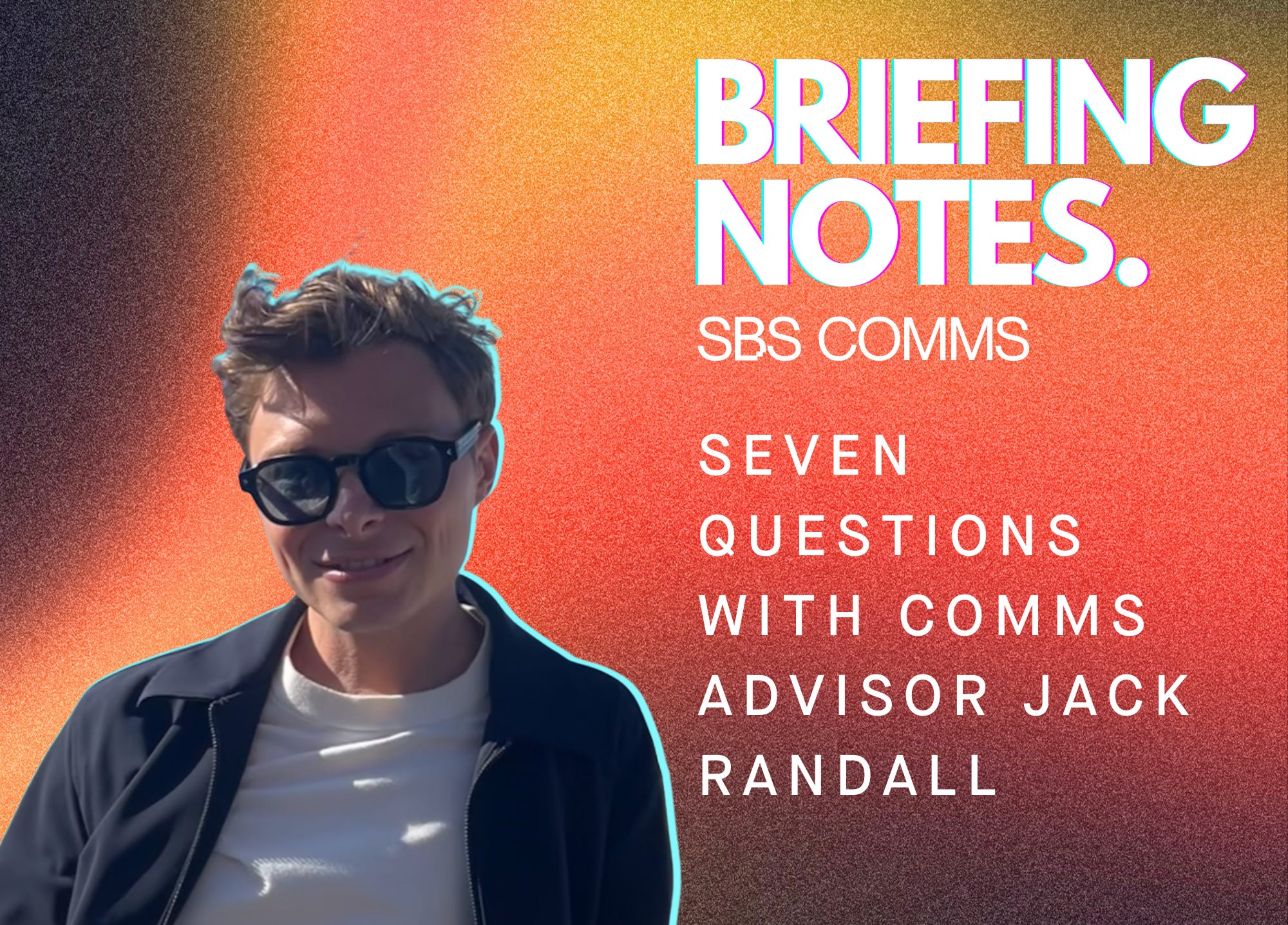
Seven Questions with Jack Randall

Tech PR has evolved from a support function into a strategic growth lever as startups scale faster and operate under heightened regulatory pressure and public attention. The stakes have never been higher for getting the story “right” the first time, especially when journalism is doing its best to keep up with innovation (AI fatigue, anyone?).
Jack Randall has had a front row seat for this shift. After an Apple internship during Katie Cotton’s PR era, Jack was Robinhood’s first comms hire and 12th employee. He helped scale Robinhood from a scrappy fintech startup into one of the most talked-about companies of the last decade. Over six years, he led product launches, funding announcements, and crisis response as the company grew to tens of millions of users and a multi-billion dollar valuation.
Since then, Jack has continued operating at the intersection of storytelling and company-building. He most recently led marketing and communications at Aetherflux, a space company founded by Robinhood co-founder Baiju Bhatt, focused on delivering renewable energy globally by collecting solar power from space. Prior to that, he led communications at OpenStore for Keith Rabois.
Today, he’s an active angel investor and works with founders on brand and communications strategy. He most recently worked with Andreessen Horowitz, Framer, Spellbook, and others.
We caught up with Jack to talk about building a strong communications program today, how the role is evolving, and what the next generation of tech PR leaders should be thinking about now.
As always, we want to hear from you! Let us know your thoughts and feedback, and don’t forget to follow us on Instagram and X.
Seven questions with… Jack Randall
You’ve helped build comms programs from the ground up multiple times, first at Robinhood, then OpenStore, and most recently at Aetherflux. What feels fundamentally different about building a PR function today compared to even five or six years ago?
My job has never been more fun. Tech optimism is back. Comms looks a lot different today than when I started my career 12 years ago. Back then – I hate that I can now say “back then” – if you wanted to get your story out, you had one way: traditional media. You’d pitch TechCrunch and Forbes, hope they’d want to cover you, and hope they’d write something accurate and positive.
There’s never been more ways to tell your story. Beyond traditional media, we have founders talking directly on social, we have live shows, Substacks, podcasts, and YouTube channels. Even print magazines covering tech are having a comeback. Technology has become culturally relevant, too. Legacy media like 60 Minutes, late-night talk shows, and Joe Rogan frequently feature tech execs.
How has this shift in the media landscape changed where you spend your time as a comms leader?
At Aetherflux, OpenStore, and in recent consulting work, traditional PR and media relations were only 30% of my focus. The other 70% was new media, social, events, and owned content.
Has the shift changed how you build teams?
Yes. I want to work with high-slope, curious, creative people who have built something in “new media” before. Maybe they vibecoded a personal website, started a Substack, shot videos for startups, or built a following on TikTok. People who understand the timeline.
What’s one way you’re taking a different approach than from your early years at Robinhood?
I now actively encourage founders to show their personalities more. Show your interests outside of work. Show that you’re a person and not just pushing product. Take Baiju, who founded Aetherflux and co-founded Robinhood. He’s charismatic, funny, and into cars, watches, and Magic: The Gathering. We leaned into all of that. He started posting on Instagram because these interests and satellite hardware are visual. He talked about cars and his childhood on The Shawn Ryan Show, politics on How Long Gone, and did a running interview on TikTok.
A decade ago at Robinhood, we only talked about the company. We prioritized company social over founders’ personal accounts. Employees knew their personalities, but the world didn’t.
Do you find companies you work with value quantitative results, like pure metrics, or qualitative, or both? Has that shifted, in one direction or another? How has that shift changed what good PR actually looks like in 2026?
I like working with founders who understand that comms is about brand building over time, and that it’s hard to measure quantitatively. I measure success by whether I helped the company achieve its business goals. If we want to raise a round, how and where can we signal momentum and growth? Where are we showing up, online and offline, to reach VCs? You know when it’s working: senior candidates apply for jobs, investors want to “catch up,” your high school classmate texts you congrats.
You’ve partnered closely with founders across a wide range of personalities and industries. From your experience, what does a great founder–comms relationship look like when it’s working at its best?
The best relationships are based on trust, discretion, and a true mind-meld. You should be able to make decisions based on what they would do. And founders should bring you in early and often to business and personnel decisions. If you disagree, you need to be able to tell them. A lot of comms people are yes-people, and that’s a problem.
As both an operator and an angel investor, what signals tell you that a company is thinking clearly about its story – even before they formally invest in communications?
Their deck, website, and memo are good signals. I can usually suss this out in my first meeting with founders. They are compelling, or they aren’t. The best founders are adept at storytelling, and for good reason. You’re constantly selling: to investors before anything’s built, to candidates leaving stable jobs, to early customers trusting you with their money.